
Agentic AI Implementation in the UAE: A Practical Deployment Guide
UAE enterprises searching for agentic ai uae implementation already understand what agentic AI is. The real question now is how to deploy it without becoming one of the pilots that never reaches production. What agentic AI actually is covers the architecture: agents that plan, use tools, and act with some autonomy rather than just answering a prompt. This guide assumes that starting point and goes straight to the deployment decision GCC enterprises are actually facing in 2026. Agentic AI adoption is accelerating across the region. UAE organizations report embedding AI agents into workflows, products, and value streams at a 97% rate, the highest KPMG's UAE Tech Report 2026 recorded across any market it surveyed. That number describes intent, not results. Most pilots stall well before they reach a system a business actually runs on.
 By: Asad Siddiq
How Is Agentic AI Implementation Different From a Pilot Project?

A pilot proves a model can work. Implementation makes sure it keeps working once real users, real data, and real failure modes show up. Most UAE teams that stall out did not fail at the model layer. They failed at ownership: who monitors the agent, who approves a tool it wants to call, and who gets paged when it does something wrong on a live system. Implementation is the layer underneath the concept: the governance, integration, and rollout plan that turns a working demo into something IT is willing to leave running unattended.
Should You Build or Buy Your Agentic AI Deployment?
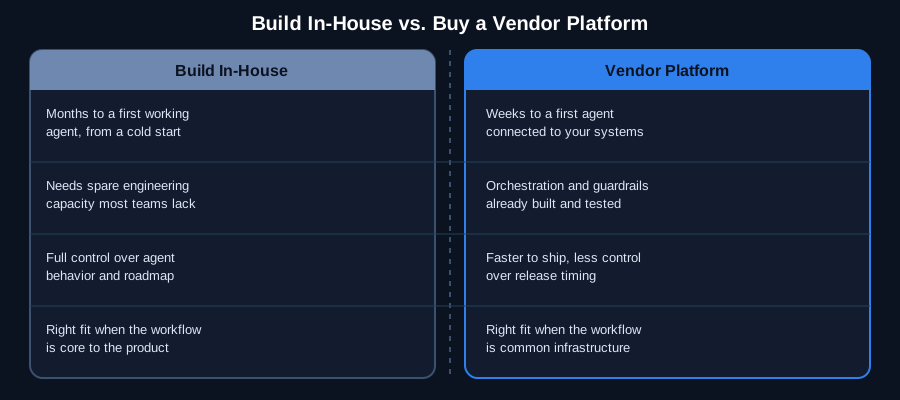
Every UAE enterprise evaluating agentic ai uae implementation faces the same fork early: build the orchestration layer in-house, or deploy on a vendor platform that already handles agent memory, tool routing, and guardrails. Neither answer is universally correct. It depends on what your engineering team already owns, how fast the business needs results, and how much of this is genuinely core to your product versus infrastructure you would rather not maintain.
A quick gut check helps before the deeper analysis: choose build if your team already ships production ML systems, the agent's tool integrations are unique to your stack, and you can name someone whose job is watching this agent for the next year, not just the next sprint. Choose buy if you need a working deployment this quarter, the workflow you are automating is common across GCC enterprises, or your engineering team is already at capacity on other priorities and adding orchestration maintenance would stretch it further.
When In-House Build Makes Sense
Build in-house when you have engineering capacity that is already idle enough to own this, when the workflow is genuinely differentiating for your business, and when you expect to iterate on agent behavior often enough that a vendor's release cycle would slow you down. This is rare in practice. Most mid-market UAE enterprises do not have a team sitting on spare capacity to build and maintain an orchestration layer, evaluation harness, and guardrail system from scratch, on top of their existing workload.
When a Vendor-Led Deployment Is Faster
Buy, or more precisely deploy on a vendor-built platform, when the workflow is common enough that someone has already solved the hard parts: tool integration, permission scopes, retries, and observability. A vendor-led deployment gets a working agent connected to your systems in weeks instead of the months a from-scratch build takes, because the orchestration layer, not just the model, is already built and already tested against failure modes your team has not hit yet. AI agent development costs in the UAE breaks down what each path actually costs, which is often the deciding factor once the build-vs-buy conversation gets specific.
What Does a Realistic Agentic AI Implementation Timeline Look Like?
A scoped pilot connected to one or two systems can go live in a matter of weeks. A production rollout that touches core systems, real customer data, and multiple departments takes months, not weeks, regardless of vendor promises. The gap between those two numbers is where most UAE implementation plans go wrong: teams scope a schedule around the pilot timeline and then get surprised when data access reviews, security sign-off, and integration testing add months to the production phase.
Discovery and Scoping
This phase maps the workflow the agent will own, the systems it needs to call, and the specific decisions it is allowed to make without a human in the loop. Skipping this step is a common cause of a rollout that starts strong and then stalls: teams that jump straight to building an agent without agreeing on scope first end up redesigning the permission model midway through, after the agent has already made a decision nobody signed off on.
Pilot With Guardrails
A real pilot runs the agent against live data with a human reviewing every action before it executes, then gradually removes that review as the agent proves itself inside its defined scope. Most of the actual engineering happens here: building the evaluation harness, defining what a wrong answer looks like, and setting up logging that lets someone reconstruct exactly why the agent did what it did.
Production Rollout and Ownership Handoff
Production means the agent runs without a human approving every step, inside guardrails narrow enough that a mistake is contained and visible fast. This is also where a named owner, not just a project team, takes responsibility for monitoring, retraining, and responding when the agent hits a case its evaluation set never covered. Enterprises that skip naming an owner here are the ones still calling the agent a pilot a year later, because nobody with the authority to call it done ever did.
Why Do Most Agentic AI Pilots Fail to Reach Production?

Deloitte's 2026 technology trends research found that 89% of enterprise AI agent pilots fail to reach production, even though 78% of enterprises have at least one agent pilot running somewhere. That gap between pilots everywhere and almost none of them shipped is the real problem agentic ai uae implementation has to solve for. A model that works in a demo is not the hard part anymore. Getting it into production, with an owner, guardrails, and a monitoring plan, is.
Common Failure Points
- No clear owner named once the pilot proves the concept, so the project stays a pilot indefinitely with nobody authorized to promote it.
- Guardrails and tool permissions scoped loosely to make the demo look impressive, then never tightened before real users touch it.
- Evaluation stops at the demo, so nobody catches drift once the agent starts handling cases the original test set never covered.
- Integration treated as an afterthought: the agent works against test data but stalls once it needs write access to a production system IT was never asked to approve.
What Makes Agentic AI Implementation Different in the UAE and GCC?
Implementation in the UAE carries two decisions that a generic global playbook skips over. The agent needs to reason well in Arabic, not just English, and the data it touches needs to sit somewhere your regulator is comfortable with. Neither is a feature to bolt on after launch. Both change the scoping conversation from day one, not after the pilot is already built.
Arabic-Language and Bilingual Workflows
A support or compliance agent that only reasons well in English will misroute or misjudge a meaningful share of GCC customer and regulatory traffic. Native Arabic handling, not a translation layer bolted onto an English-first model, needs to be part of the evaluation criteria before you pick a build path or a vendor. Retrofitting language coverage after a pilot has already been scoped around English test data is slower and more expensive than building it in from the start.
Data Residency and Regulatory Fit
Where the agent's data lives and how it gets logged is a compliance question, not an infrastructure afterthought. Sovereign AI and data residency requirements shape what an implementation plan can even propose in regulated sectors like finance and healthcare. Settle this during discovery and scoping, not after a vendor contract is signed and the integration team discovers the platform cannot meet a data residency requirement legal assumed was non-negotiable. A vendor built for global markets first and the GCC second often treats this as a configuration option. Confirm it is actually enforced, not just offered, before you rely on it during an audit.
What Team and Skills Does Agentic AI Implementation Require?
A working implementation needs fewer specialized AI hires than most UAE enterprises assume, and more of the roles they already have pulled in earlier. An engineer who understands the systems the agent will call matters more at this stage than a machine learning researcher, because the failure modes are almost always integration and permissions, not model quality.
- An implementation owner with the authority to approve scope, guardrails, and the promote-to-production decision.
- An engineer who owns the tool integrations and API access the agent needs, and who can debug it when a call fails.
- Someone accountable for evaluation: defining what a correct action looks like and reviewing flagged cases as volume grows.
- A compliance or security reviewer who signs off on what data and systems the agent can touch before it goes live.
Frequently asked questions
Should a UAE enterprise build or buy its agentic AI implementation?
Build in-house only when the workflow is genuinely core to the product and engineering has spare capacity to own an orchestration layer long-term. Most mid-market UAE enterprises get to a working, guardrailed deployment faster and cheaper on a vendor platform, since the integration, permission, and retry logic is already built and tested.
How long does agentic AI implementation take for a UAE enterprise?
A scoped pilot connected to one or two systems can go live in weeks. A production rollout that touches core systems, real customer data, and multiple departments takes months once security review, data access approval, and integration testing are factored in. Plan the schedule around the production phase, not the pilot.
Why do most agentic AI pilots fail to reach production?
Deloitte's 2026 technology trends research found 89% of enterprise AI agent pilots fail to reach production. The common causes are not model quality: no named owner once the pilot works, guardrails scoped loosely for a demo and never tightened, and evaluation that stops instead of catching drift once real volume hits.
What team and skills does agentic AI implementation require?
Fewer specialized AI hires than most teams assume. The roles that matter are an implementation owner with authority to approve scope and promotion to production, an engineer who owns the tool integrations, someone accountable for evaluation and flagged-case review, and a compliance or security reviewer who signs off on data and system access.
Want this built for your team?
We ship production-grade AI like this across every industry, in weeks, not months.