
Contract Review AI: Where It Helps and Where It Doesn't
AI contract review is a first-pass triage tool, not a lawyer replacement. Done well, it flags non-standard clauses and missing terms across a stack of contracts in minutes instead of hours, done badly, it gives false confidence on documents nobody actually re-read. This guide covers what it reliably automates, where it fails by design, the Arabic-language gap most vendors haven't solved, and how to evaluate one properly.
 By: Asad Siddiq
UAE legal teams reviewing high volumes of vendor agreements, leases, or employment contracts face the same bottleneck: every document needs a first pass before it's worth a lawyer's time. That's the actual use case document intelligence solves. Not autonomous contract drafting, and any vendor pitching the latter is overselling.
What Can Contract Review AI Reliably Automate?
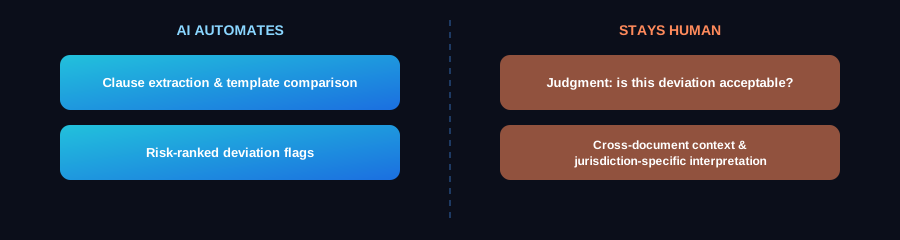
Clause extraction and comparison against a standard template. The system flags where a contract deviates: a shortened notice period, a missing indemnification clause, an unusual termination trigger. Those deviations surface for a lawyer to evaluate, ranked by risk. It doesn't decide whether a deviation is acceptable. That judgment call stays human.
Clause Extraction and Standard-Template Comparison
The system builds a structural map of the contract, parties, term, payment, termination, indemnification, governing law, and checks each section against your organization's standard template or a market-standard reference. Anything present in the template but missing from the contract gets flagged as a gap, not just deviations that are present but different.
Risk Ranking, Not Just Flagging
A useful system doesn't just list every deviation flat. It ranks them by risk category, so a lawyer's attention goes to the shortened liability cap before the cosmetic formatting difference in the notice clause. That ranking is what turns a 40-page flag list into something a lawyer can actually act on inside a normal review window.
Where Does It Actually Fail?
These aren't bugs to be patched later; they're structural limits of what a pattern-matching system can reliably judge, and any legal team deploying one needs to plan around them, not hope they go away with a bigger model.
- Novel clause language it hasn't seen before, it flags the anomaly but can't assess intent.
- Scanned or low-quality Arabic contracts without OCR tuned for legal document structure.
- Cross-document context, like whether a clause conflicts with a separate side letter.
- Anything requiring jurisdiction-specific legal interpretation. That's a lawyer's call, always.
Why Cross-Document Context Is the Hardest Failure Mode
A single contract can look perfectly standard in isolation while conflicting with a side letter, an amendment, or a master services agreement signed separately. Most contract review systems evaluate one document at a time and have no visibility into that broader document set, which means a legal team still needs a human process for tracking related-document conflicts, AI or not.
Does It Need to Handle Arabic-Language Contracts?
For most UAE legal teams, yes. A system tested only on clean, born-digital English contracts will misread scanned Arabic agreements and mixed-language clauses common in the region. This is the same regional gap our Generative AI & LLMs work is built around, native Arabic handling, not a translation layer bolted on after.
Translation Layer vs. Native Arabic Legal NLP
A translation-layer approach converts Arabic text to English before running the same English-trained clause model. And loses legal nuance in that conversion, particularly around terms that don't map cleanly between legal systems. Native Arabic legal NLP is trained directly on Arabic legal document structure, so it doesn't lose that nuance in an intermediate translation step.
Scanned Document Quality Is the Silent Failure Point
Many older UAE contracts exist only as scanned images, sometimes low-resolution or fax-quality. OCR tuned for general documents frequently misreads legal-specific formatting like numbered clause hierarchies and bilingual side-by-side layouts. Ask any vendor to test on your actual scanned archive, not a clean sample set, before trusting their extraction accuracy.

A contract review AI that can't say 'I'm not confident here' is more dangerous than no AI at all.
What Does It Cost, and What's the Realistic ROI?
Pricing for contract review AI typically scopes to document volume and complexity rather than a flat platform fee; a firm reviewing dozens of standard vendor agreements a month has a very different cost profile than one reviewing complex, bespoke commercial contracts.
Where the Time Savings Actually Show Up
The savings aren't in eliminating legal review, they're in compressing the first pass. A lawyer who used to spend 45 minutes manually scanning a standard vendor agreement for deviations can review the same contract in 10-15 minutes when the deviations are already flagged and ranked. Multiply that across a high-volume contract stack and the time savings compound fast, even though every flag still gets a human look.
The Hidden Cost Most Firms Underestimate
Implementation isn't just the software. It's building and maintaining the standard-template library the system compares against, and training the legal team on how to interpret confidence scores and risk rankings correctly. Firms that budget only for the software and not for that setup work are the ones most likely to underuse the tool after the first month.
How Should a Legal Team Evaluate a Vendor?
Ask for a live test on your actual contract types, not a demo deck. Ask specifically how the system handles a clause it hasn't seen before, and whether it surfaces a confidence score per flag. If a vendor can't answer both, they haven't built for the failure case, which is the case that actually matters.
A Practical Evaluation Checklist
- Test on your actual contract stack, including scanned and Arabic-language documents, not a curated demo set.
- Confirm every flag ships with a confidence score, not a binary yes/no on deviation.
- Ask how the system behaves on a clause type it has never encountered before.
- Check whether outputs integrate with your existing document management and matter workflow, or require a new tool.
Talk to us about scoping a pilot against your real contract stack before committing to anything.
What Does a Pilot Actually Involve?
A well-run pilot follows a predictable shape, and knowing it in advance helps a legal team evaluate whether a vendor's proposed process is real or just a sales gesture.
Building the Standard-Template Reference
Before any contract gets analyzed, the system needs your organization's standard template or market-standard reference to compare against. This is usually the most time-consuming setup step, and it's where a legal team's own expertise matters most, the template needs to reflect what your organization actually considers standard, not a generic industry default.
Running the Pilot Against a Real Contract Batch
A representative pilot runs against 20-50 real contracts from your actual stack. Including a mix of clean, standard agreements and known problem contracts your team has already manually reviewed. Comparing the system's flags against what your lawyers already found by hand is the clearest accuracy signal you'll get before a full rollout.
Measuring What Actually Matters
Track both false negatives (real deviations the system missed) and false positives (flags that weren't actually meaningful deviations) separately. A system with a low false-negative rate but a high false-positive rate is still useful; it just means lawyers spend more time filtering flags. A high false-negative rate is the one that should stop a rollout.
How Does This Change Day-to-Day Workflow for a Legal Team?
The tool's value shows up less in any single review and more in how it reshapes where a legal team spends its time across a week.
Shifting From Line-by-Line Reading to Exception Review
Lawyers stop reading every clause of every contract in sequence and instead review a ranked list of flagged deviations first, reading the full document only when the flags warrant it or the contract falls outside standard categories entirely. That shift alone is where most of the time savings live.
Freeing Senior Time for Genuinely Novel Agreements
With routine contracts moving faster through review, senior lawyers get more time for the bespoke, high-stakes agreements that actually need their judgment, the ones the system correctly can't handle alone. That reallocation, not raw speed, is usually the bigger organizational win.
Keeping Junior Lawyers Trained, Not Just Faster
A real risk of AI-assisted review is junior lawyers losing the manual-review reps that build clause-level judgment over time. Firms that keep this in mind deliberately rotate junior staff through a mix of AI-assisted and fully manual reviews, so the tool speeds up the routine work without hollowing out the training pipeline for the judgment calls it can't make.
Frequently asked questions
Can AI replace a lawyer for contract review in the UAE?
No. AI contract review automates first-pass flagging of clause deviations and missing terms; the legal judgment on whether a deviation is acceptable stays with a qualified lawyer.
Does contract review AI work on scanned Arabic contracts?
Only if it's been specifically tested and tuned on scanned Arabic legal documents, most off-the-shelf tools are built for clean, born-digital English contracts and misread Arabic legal structure.
How accurate is AI at catching non-standard clauses?
Accuracy depends on how well the system's standard template matches your actual contract types. Ask any vendor for a live test on your real contracts, not a generic demo, before trusting a number.
What should a UAE law firm ask before buying contract review AI?
Ask how the system handles clause language it hasn't seen before, whether it shows a confidence score per flag, and request a live test on your actual contract stack.
Is contract review AI worth it for a small legal team?
It's most valuable where document volume is the bottleneck. A small team reviewing a handful of contracts a week gets less leverage than a team processing dozens of vendor or lease agreements.
Want this built for your team?
We ship production-grade AI like this across every industry, in weeks, not months.