
Anomaly Detection: Catching Threats Traditional Tools Miss
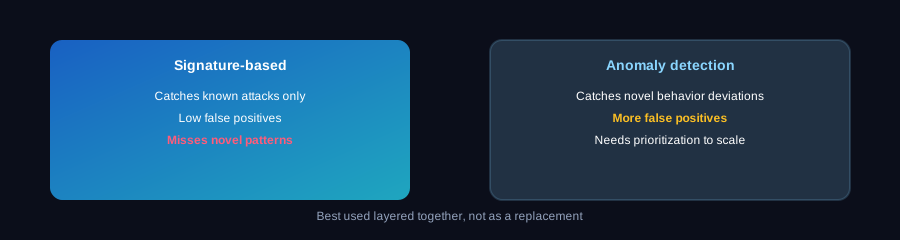
Signature-based security tools only catch attacks that match a known pattern. By definition, they miss novel ones. AI anomaly detection flags behavior that deviates from an established baseline instead, catching threats a signature has never seen, at the cost of more false positives that need tuning. This guide covers how baseline detection works, the false-positive tradeoff, how to keep a SOC team from burning out on noise, and where to start.
 By: Asad Siddiq
Every signature-based security tool has the same blind spot: it can only catch what it already knows to look for. UAE enterprises facing increasingly novel attack patterns need a layer that flags behavior, not just known signatures; which is exactly what machine learning-based anomaly detection is built for.
How Does Anomaly Detection Catch What Signatures Miss?
It builds a baseline of normal behavior, for a user, a system, or network traffic, and flags meaningful deviations from that baseline, regardless of whether the deviation matches a known attack signature. A credential compromise that behaves nothing like malware still shows up as anomalous login timing or access pattern, which is exactly the gap signature tools can't close.
User and Entity Behavior Analytics (UEBA)
The most common application is UEBA, modeling normal behavior per user and system entity, then flagging deviations like a login from an unusual location at an unusual hour, or a service account suddenly accessing resources it's never touched before. Credential compromise and insider threats show up here even when the attacker uses entirely legitimate-looking tools.

Network Traffic Anomaly Detection
The same baseline principle applies to network traffic patterns: unusual data volumes, new destination endpoints, or traffic timing that doesn't match normal business patterns. This is where anomaly detection catches early-stage lateral movement or data exfiltration attempts that don't match any known malware signature.
What's the Real Tradeoff Security Teams Need to Manage?
- More false positives than signature-based tools; anomaly doesn't always mean malicious.
- Requires a clean baseline period to learn 'normal' before it's reliable.
- Needs tuning per environment, a baseline for one network doesn't transfer to another.
- Works best layered alongside signature-based tools, not as a full replacement.
Why a Clean Baseline Period Matters More Than Model Choice
If the baseline period includes an undetected compromise or an unusual but legitimate event (a one-off system migration, for instance), the model learns the wrong definition of 'normal.' Most deployments need 30-90 days of monitored, ideally incident-free activity before the baseline is reliable enough to trust for alerting.
How Do You Keep False Positives From Burning Out a SOC Team?
Confidence scoring and alert prioritization, not raw anomaly flagging. The system should rank anomalies by severity and context so a security operations team investigates the highest-risk deviations first, instead of drowning in low-signal alerts. That prioritization discipline is what makes anomaly detection sustainable at scale, not just accurate in a demo.
Context-Aware Severity Scoring
Not every anomaly deserves the same response. A login-location anomaly on a low-privilege account is a different severity than the same anomaly on a domain admin account. Severity scoring that factors in asset value and privilege level, not just how statistically unusual the behavior is, is what keeps the highest-risk alerts from getting lost in volume.
Feedback Loops That Improve the Model Over Time
Every analyst decision, confirmed threat, false positive, benign-but-unusual, should feed back into the model's tuning. Without that feedback loop, the false-positive rate stays flat indefinitely instead of improving as the SOC team's investigations accumulate real signal.
An anomaly detector that floods your SOC with noise gets ignored within a month. Prioritization is the actual product.
How Does Anomaly Detection Fit Into a Broader Security Stack?
Anomaly detection isn't a standalone product decision; it's a layer that needs to integrate with whatever SIEM, SOAR, or existing monitoring tools your security team already relies on.
Integration With Existing SIEM and Alerting Tools
Anomaly alerts should flow into the same platform your SOC team already monitors, correlated alongside signature-based alerts, not sit in a separate dashboard nobody checks consistently. That correlation is often where the real value shows up, an anomaly alert combined with a signature-based alert on the same asset is a much stronger signal than either alone.
Building the Case for Investment Internally
Security leadership evaluating anomaly detection spend should frame it against the cost of the novel-attack blind spot specifically, not against signature-tool replacement. It's an addition to the stack, not a swap, and the business case should reflect that framing accurately.
Where Should a UAE Enterprise Start?
Scope anomaly detection around one high-value asset class, privileged account activity or a specific network segment, rather than deploying it enterprise-wide on day one.
Picking the Right First Asset Class
Privileged account activity is usually the highest-value starting point: the volume of activity is manageable enough to build a clean baseline quickly, and the stakes of a compromise are high enough that even a handful of true positives justifies the deployment. Expand to broader network traffic monitoring once that first baseline is proven and tuned.
Talk to us about which asset class gives the clearest baseline and fastest signal for your environment.
What Does a Deployment Timeline Realistically Look Like?
Setting expectations on timeline upfront avoids the common mistake of expecting reliable alerting in week one.
Weeks 1-4: Baseline Learning Period
The system monitors the target asset class without alerting, building its model of normal behavior. This period needs to be as free of undetected incidents as possible; running it during a known-clean operational window produces a far more reliable baseline than running it during a period of known instability.
Weeks 5-8: Shadow Alerting and Tuning
The system starts generating alerts, but they're reviewed by the security team without triggering any automated response yet. This is where severity scoring and false-positive tuning happen against real analyst feedback, before the alerts are trusted to drive real-time response.
Weeks 9+: Live Alerting Integrated Into SOC Workflow
Once the false-positive rate is manageable and severity scoring is validated, alerts integrate into the live SOC workflow alongside signature-based tools, with the feedback loop from analyst decisions continuing to refine the model over time.
What Skills Does a SOC Team Need to Run This Effectively?
Anomaly detection changes what a SOC analyst's day looks like, and teams that don't adjust their workflow and training alongside the technology underuse it badly.
Investigating Behavioral Alerts vs. Signature Alerts
A signature-based alert usually comes with a known attack pattern to investigate against. A behavioral anomaly alert requires the analyst to actually understand why the behavior is unusual, which system, which user, what changed, before deciding whether it's a threat. That's a different investigative skill, and it's worth training for explicitly rather than assuming it transfers automatically.
Closing the Loop on Every Alert Decision
The feedback loop that improves the model over time only works if analysts consistently log their verdict on each alert, confirmed threat, false positive, or benign-but-unusual, rather than just closing tickets. Teams that skip this step see their false-positive rate stay flat indefinitely instead of improving.
How Should Success Be Reported to Leadership?
Security leadership evaluating whether the investment is paying off needs metrics that go beyond raw alert counts, which say little about actual value delivered.
Metrics That Show Real Security Value
Track confirmed novel threats caught that signature tools would have missed, mean time to investigate a behavioral alert, and the trend in false-positive rate over time as the model tunes. These three, reported quarterly, tell a far more honest story than a raw count of alerts generated.
Framing ROI Without Overstating It
It's tempting to attribute every prevented incident to the anomaly detection layer, but most real catches involve it working alongside existing signature tools and analyst judgment. A credible ROI report attributes value honestly, as one layer that closed a specific, real gap, rather than claiming sole credit for every good outcome in the reporting period.
Revisiting the Baseline as Your Environment Changes
A network or user-behavior baseline that was accurate at deployment drifts as your organization grows, adopts new tools, or changes how teams work. Periodic baseline review, not a one-time setup step, keeps the model's definition of 'normal' from quietly going stale and driving up false positives over time.
Frequently asked questions
How is AI anomaly detection different from traditional antivirus or signature-based tools?
Signature-based tools only catch attacks matching a known pattern. Anomaly detection flags behavior that deviates from an established baseline, catching novel threats a signature has never seen.
Does anomaly detection replace signature-based security tools?
No, it works best layered alongside signature-based tools, catching what they miss, rather than replacing them outright.
Why does anomaly detection produce more false positives?
Because it flags any meaningful deviation from normal behavior, and not every deviation is malicious. Managing that tradeoff through alert prioritization is what makes it usable at scale.
How long does anomaly detection need to learn what's 'normal'?
It requires a clean baseline period specific to each environment before it's reliable. The exact length depends on the asset class and available historical data.
Where should a UAE enterprise deploy anomaly detection first?
Start narrow: one high-value asset class like privileged account activity or a specific network segment, rather than an enterprise-wide rollout on day one.
Want this built for your team?
We ship production-grade AI like this across every industry, in weeks, not months.