
AI Transaction Monitoring & AML Compliance for UAE Banks
Banks and exchange houses searching for ai transaction monitoring dubai are usually responding to one of two pressures. Either a recent CBUAE finding on their AML controls, or a false-positive rate so high genuine suspicious activity gets buried in noise. In 2025 the Central Bank of the UAE issued over AED 370 million in AML/CFT fines, citing weak transaction monitoring as a recurring cause. Static, rule-based monitoring catches the obvious cases. It misses structured transactions designed to stay under fixed thresholds. This guide covers how AI transaction monitoring works, what CBUAE's enforcement pattern signals, and what to look for before deploying it.
 By: Asad Siddiq
Why Is CBUAE Enforcement on AML Intensifying?

The scale of 2025's enforcement was unusual. A single exchange house received a record AED 200 million penalty. Regulators cited pervasive AML/CFT control failures, including weak customer due diligence and weak transaction monitoring. Multiple foreign bank branches were separately fined for related failings. The pattern across these actions is consistent. Institutions relied on static, threshold-based monitoring rules that had not been updated. Those rules missed structuring (splitting transactions to stay under reporting thresholds) and layering (moving funds through multiple accounts to obscure origin). CBUAE's enforcement approach through 2025 and into 2026 makes one thing clear. A monitoring system a bank cannot explain is itself a control failure. So is one that generates so many false positives that compliance staff routinely dismiss real alerts. Both count as failures, independent of whether any actual money laundering is later proven.
What Is AI Transaction Monitoring and How Does It Differ From Rule-Based Systems?
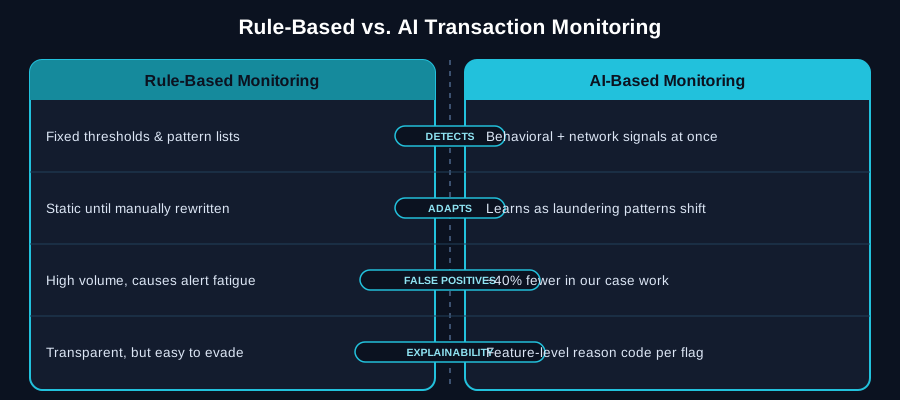
Rule-based AML monitoring flags transactions against fixed thresholds and pattern lists: any transfer over a set amount, any transaction with a sanctioned jurisdiction, any account with more than a set number of transfers in a day. These rules are transparent, but brittle. Sophisticated actors can design around them easily. They are also blunt enough to flag large volumes of entirely legitimate activity. AI-based monitoring instead scores each transaction against dozens of behavioral and contextual signals at once. It weighs transaction velocity against an account's own history, network patterns across related accounts, and geographic and timing anomalies. It produces a risk score that adapts as laundering techniques evolve, rather than staying fixed until someone manually rewrites the rule set.
Does AI Transaction Monitoring Survive a CBUAE Audit?
Only if it is built to be explainable from day one. A black-box model that produces a risk score without a feature-level breakdown is a liability under CBUAE's audit standards, not an improvement over rule-based monitoring. A compliance officer cannot defend a decision they cannot explain when a regulator asks. This is the same principle covered in our piece on fraud detection you can explain to a regulator. Gradient-boosted models and similar approaches can produce a feature-importance breakdown for every flagged transaction. That breakdown shows exactly which signals, velocity, network pattern, geography, drove the score. The audit trail exists at the moment of the decision, rather than being reconstructed after the fact.
What Does a Rule-Based Flag Look Like Next to an ML-Scored One?
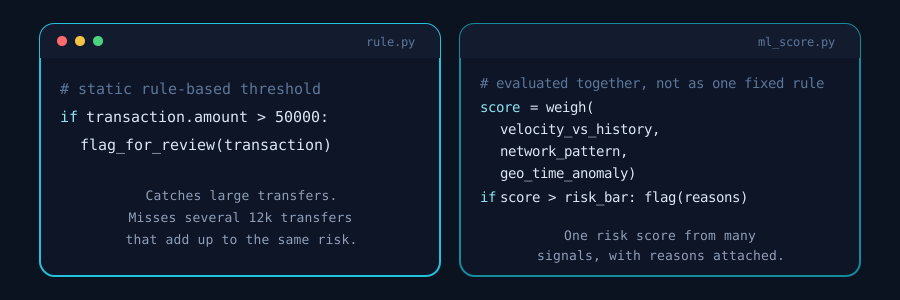
A static rule like "flag any transfer over 50,000" is easy to read and easy to design around: split the same amount into four transfers of 12,500 and the rule never fires. An ML-scored approach does not check one number against one threshold. It weighs transaction velocity against the account's own history, patterns across related accounts, and timing or geographic anomalies, together, into a single risk score with reasons attached. That is what lets it catch structuring a fixed threshold was never built to see.
What an Audit-Ready AI Monitoring System Needs
- A feature-importance or reason-code breakdown attached to every flagged transaction, generated at scoring time, not after the fact.
- Version control on the model itself, so a regulator can trace which model version made a historical decision.
- A documented retraining and validation process, since a monitoring model that hasn't been revalidated against new laundering patterns degrades quietly.
- Integration with existing case-management and FIU-reporting workflows, not a parallel system compliance staff have to reconcile manually.
What Results Should Banks Expect From AI Transaction Monitoring?

Based on our work applying explainable, adaptive fraud and risk-scoring models in financial services, the highest-use result is usually a sharp cut in false positives. Our own anonymized case work in financial services saw a 40% reduction in false positives after moving from static thresholds to an explainable model. That frees compliance analysts to spend their time on genuinely suspicious activity instead of clearing noise. That reduction matters for AML specifically, because alert fatigue is itself a documented cause of the enforcement failures CBUAE has been citing. A compliance team that dismisses ten false alerts a day is statistically more likely to also dismiss the eleventh, genuine one.
What Does a Feature-Importance Breakdown Actually Show a Compliance Officer?
When a transaction gets flagged, the breakdown lists the specific signals that drove the score and how much each one contributed, for example: unusual transfer velocity for this account (high weight), first-time counterparty in a higher-risk jurisdiction (medium weight), transaction time outside the customer's normal pattern (low weight). A compliance officer reads that list, checks it against the case file, and can explain the decision to an examiner in the same terms the model used. That is a materially different position than trying to reverse-engineer why a black-box score came out high.
How Should a Bank Start an AI Transaction Monitoring Project?
Start narrow. Deploy the model alongside the existing rule-based system rather than replacing it outright. Compare flagged transactions between the two approaches over a defined period. Use that comparison to build the internal audit trail a regulator will eventually ask to see. This parallel-run approach proves the model's value in false-positive reduction. It also gives compliance and audit teams time to build confidence in the explainability layer before it becomes the system of record.
Does This Apply to Exchange Houses and Money Service Businesses Too?
Yes, and arguably more urgently. CBUAE's 2025 enforcement pattern included a record penalty against an exchange house specifically for AML control failures. Exchange and remittance houses tend to process the transaction types, structured cash deposits, cross-border remittances, third-party transfers, that static rule sets are worst at catching. An exchange house's transaction volume also tends to be dominated by legitimate, high-frequency small transfers. That is exactly the pattern that produces the highest false-positive load on a rule-based system. It is also where a model gains the most by distinguishing routine remittance behavior from an anomalous pattern within that same customer base. The same shared-infrastructure approach covered across banks, fintechs and exchange houses applies here directly.
What Should Compliance Teams Watch for After Deployment?
Deploying the model is not the end of the compliance work. A monitoring model needs periodic revalidation against new laundering typologies. The patterns CBUAE cites in enforcement actions evolve as institutions close off the previous generation of exploits. Compliance teams should treat model revalidation with the same seriousness as a rule-set review under a legacy system: on a fixed schedule, documented, and tied to a specific sign-off. Not an informal check whenever someone happens to notice a shift in flagged volume.
How Should a Bank Handle Alert Fatigue During the Transition?
Running two systems in parallel, as recommended above, creates its own short-term problem: more total alerts to review, not fewer, while both systems are active. The fix is triage, not brute force. Route transactions both systems agree are high risk straight to senior analysts. Route transactions only the AI model flags to a separate review queue built specifically to validate the model, since that is where false positives or missed patterns will show up first. Transactions only the old rules flag, once the parallel run has enough history, become the evidence base for retiring specific rules that add noise without adding coverage.
What Does Model Governance Look Like Once the System Is Live?
Deploying an explainable model is the start of a governance obligation, not the end of one. A monitoring model that scored transactions accurately at launch can drift the same way a fraud model does, as legitimate customer behavior and laundering techniques both change over time. Compliance and model-risk teams need a shared, documented process, not two separate ones that happen to look at the same system from different angles.
- A fixed revalidation schedule, tied to a specific sign-off, not an informal check after someone notices a volume shift.
- Version control that ties every historical flag to the exact model version that generated it.
- A documented process for retiring or updating individual model features as new typologies emerge, mirroring how a rule-based system retires individual rules.
Frequently asked questions
Why is CBUAE increasing AML enforcement in 2025-2026?
CBUAE fined UAE financial institutions over AED 370 million in 2025 for AML/CFT failures, with enforcement actions repeatedly citing weak transaction monitoring, inadequate due diligence, and delayed reporting to the Financial Intelligence Unit as root causes.
How does AI transaction monitoring differ from rule-based AML systems?
Rule-based systems flag transactions against fixed thresholds, which are transparent but easy to design around and prone to high false-positive rates. AI models score transactions against many behavioral and network signals simultaneously and adapt as laundering patterns evolve.
Can an AI transaction monitoring system pass a CBUAE audit?
Yes, provided it produces a feature-level explanation for every flagged transaction at the time of scoring, along with model version control and a documented retraining process, so a compliance officer can defend every decision to a regulator.
How much can AI reduce false positives in AML monitoring?
Anonymized financial-services case work applying explainable AI risk-scoring models has seen false positives drop by roughly 40% compared to static, rule-based thresholds.
Can a bank run AI and rule-based AML monitoring at the same time?
Yes, and it is the recommended approach during a transition. Running both in parallel for a defined period lets a bank compare flagged transactions, build the audit trail a regulator will ask for, and give compliance staff time to build confidence in the new model before it becomes the system of record.
What specific information does a feature-importance breakdown include?
It lists the individual signals that drove a transaction's risk score, such as unusual transfer velocity, an unfamiliar counterparty jurisdiction, or an off-pattern transaction time, along with how heavily each one weighed into the final score, so a compliance officer can explain the decision in the same terms the model used.
Who should own model revalidation for AML monitoring, compliance or the data science team?
Both, on the same schedule. Compliance defines what a passing revalidation looks like against current typologies and regulatory expectations, while the data science or model-risk team runs the technical check. Splitting this into two unconnected processes is how a stale model survives past its revalidation date unnoticed.
Want this built for your team?
We ship production-grade AI like this across every industry, in weeks, not months.