
Cloud Modernization & MLOps for UAE Banks: A Practical Roadmap
UAE banks searching for cloud services for banks uae are usually solving two problems at once. First, legacy core-banking infrastructure that cannot scale to real-time AI workloads. Second, a Central Bank that has historically kept banks on private, on-prem infrastructure for security. CBUAE's own Guidelines for Financial Institutions Adopting Enabling Technologies permit cloud computing with the right audit and exit rights. Its 2026 sovereign cloud partnership with Core42 shows the regulator moving toward cloud, not away from it. This roadmap covers what a compliant cloud modernization and MLOps program actually looks like for a UAE bank.
 By: Asad Siddiq
Why Have UAE Banks Been Slow to Adopt Public Cloud?

It is a regulatory posture, not a technology gap. CBUAE's enabling-technology guidelines require banks to prove two things. First, they can exit a cloud vendor relationship without service disruption. Second, they keep full audit visibility into how data is processed. Both are straightforward to prove on private cloud or on-prem infrastructure. Both are much harder to prove on shared public infrastructure. As a result, most UAE bank CIOs default to private cloud and on-premise deployment for anything touching customer data or transaction processing. They reserve public cloud for lower-risk workloads, like marketing analytics or internal tooling. That default is now shifting. PwC's 2025 analysis of secure cloud adoption for central banks finds the same pattern across the region: private-cloud-first, moving cautiously toward hybrid models as sovereign cloud options mature.
What Does CBUAE Actually Require for Cloud-Based AI Workloads?
The enabling-technology guidelines set out four practical requirements. The bank must be able to audit how and where data is processed. The vendor contract must guarantee an exit path that does not disrupt service. The bank must maintain oversight of subcontractors the cloud vendor uses. And the bank must show resilience against the specific outage and breach scenarios cloud introduces. None of these rule out cloud AI infrastructure. They rule out signing a standard hyperscaler enterprise agreement without a compliance review. That is the mistake that actually gets flagged in CBUAE audits.
How Do Exit Rights Get Tested in an Actual Examination?
A CBUAE examiner does not take a vendor's contract clause at face value. They ask the bank to walk through what a full data export and service cutover would actually look like: how long it takes, what format the data leaves in, and whether any vendor-proprietary format would trap the bank mid-migration. Banks that have never rehearsed this answer it poorly. Banks that treat the exit plan as a living document, tested annually alongside a disaster-recovery drill, answer it in minutes.
How Does the 2026 Sovereign Financial Cloud Change This?
In February 2026, the Central Bank of the UAE and Core42 announced a sovereign financial cloud built specifically for regulated financial workloads. It gives banks a nationally aligned infrastructure option. It is designed around CBUAE's own audit and residency requirements, not a generic global cloud contract retrofitted to satisfy them. For a bank planning a multi-year MLOps program, this matters directly. Workloads that would previously have stayed on private on-prem infrastructure now have a cloud-native path that starts compliant, instead of ending there after a lengthy review. It does not remove the need for a compliance assessment. But it changes the starting point, from a generic hyperscaler agreement to infrastructure purpose-built for the sector.
What Is MLOps and Why Do Banks Need It Specifically?
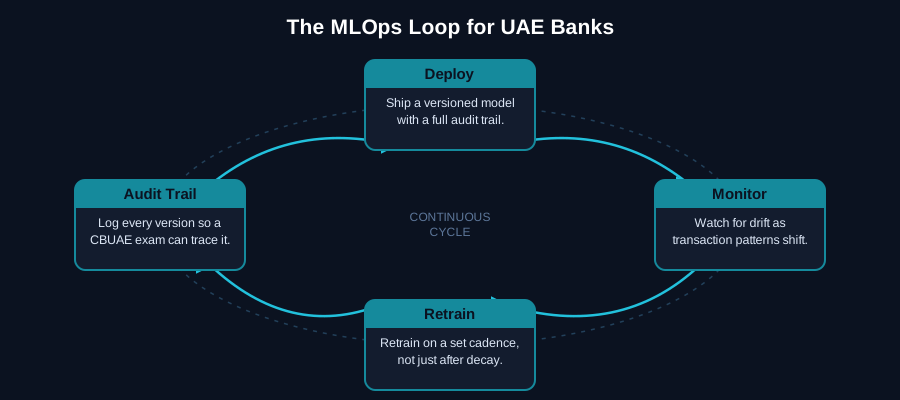
Getting a fraud-detection or credit-scoring model into production is the easy half. MLOps is the operational discipline that keeps it honest afterward. It monitors for data drift as customer behavior shifts. It retrains on a schedule instead of an ad hoc basis. It versions every model so a regulator can trace which version made which decision. It rolls back instantly if a new model version underperforms in production. UAE banks face a compliance dimension most industries don't. Every model version and every retraining event needs an audit trail that survives a CBUAE examination. Model versioning and decision logging aren't optional engineering nice-to-haves here. They're the same requirement that drives explainable fraud detection more broadly.
Skipping any one of these disciplines shows up the same way every time: a model that performed well at launch quietly degrades as fraud patterns shift, and nobody notices until a spike in missed cases forces a manual review months later. By then, the bank is explaining a gap to a regulator instead of pointing to a monitoring dashboard that caught it in week one.
The Core MLOps Components a Bank Needs
- Model versioning and a decision audit trail tied to every production inference, not just training runs.
- Automated drift monitoring that flags when live transaction patterns diverge from training data.
- A defined retraining cadence, not reactive retraining only after performance visibly degrades.
- Rollback capability that can revert to a previous model version within minutes, not days.
- Separation of the MLOps pipeline's access controls from general IT access, matching CBUAE's audit-visibility requirement.
What Does a Drift-Detection Threshold Actually Look Like?
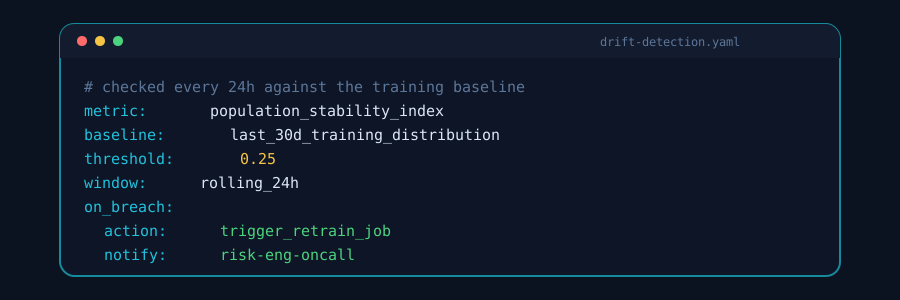
This config checks the population stability index (PSI) between live transaction data and the training baseline every 24 hours. PSI is a standard metric for how far a live data distribution has drifted from what a model was trained on. When it crosses 0.25, a threshold widely used in production monitoring, the system automatically kicks off a retraining job and pages the risk engineering team instead of waiting for someone to notice degraded accuracy in a monthly report.
What Does a Practical Modernization Sequence Look Like?

Banks that modernize successfully do not attempt a full core-banking cloud migration up front. They start with a single, well-scoped AI workload, usually fraud detection or KYC document processing. They deploy it on private or sovereign cloud with MLOps built in from day one. They use that engagement to prove the compliance model to internal risk and audit teams before expanding. One workload, one compliance review, one production MLOps pipeline, then expand. That is the same approach behind the fraud detection and KYC automation covered in our banking guide. It avoids the far more common failure mode: a bank commits to a multi-year infrastructure overhaul before any single AI workload has proven its compliance posture in production.
Who Should Own a Bank's Cloud Modernization Program?
The programs that stall are usually the ones where IT owns the cloud migration and risk or compliance is consulted only at the review gate near the end. The programs that ship on schedule involve compliance and risk teams from the architecture phase. They review the vendor contract's audit and exit-rights clauses before infrastructure is provisioned, not after a workload is already running on it. This is not a bureaucratic formality. CBUAE examinations look specifically at whether audit and exit rights were contractually guaranteed from the start. A retrofit after the fact is harder to negotiate with a vendor and harder to defend to a regulator than a requirement built into the original agreement.
What Goes Wrong When a Bank Skips MLOps Entirely?
The failure mode is rarely a single dramatic incident. It is a fraud model trained in 2024 still scoring transactions in 2026 with no retraining schedule, a credit model with three silently updated versions and no record of which one made which decision, or a monitoring dashboard nobody has checked in months because no alert was wired to page anyone. Each of these looks fine until a CBUAE examiner or an internal audit asks a specific question the bank cannot answer.
- A model quietly degrades because nobody is watching for drift, and the first sign is a spike in missed fraud cases.
- A regulator asks which model version flagged a specific transaction, and no version log exists to answer.
- An audit finds a retraining process that only ever ran once, at launch, three years ago.
None of these gaps need an expensive rebuild to fix. Version control on model artifacts, a scheduled drift check like the one above, and a documented retrain cadence are a few weeks of engineering work layered onto an existing pipeline. The larger cost comes from waiting until an examiner finds the gap, not from building the monitoring in the first place.
What Does This Cost, and What Is the Realistic Timeline?
Timelines vary with how legacy the existing core-banking stack is. But the pattern that works reliably is a 6-10 week first workload. That covers infrastructure assessment, a scoped pilot (fraud detection or KYC document processing are the two fastest to show value), and an MLOps pipeline with monitoring and rollback built in from day one. A compliance review with risk and audit follows before expanding to a second workload. Banks that try to shortcut the compliance review to move faster on the first workload almost always lose more time later. They lose it either in a delayed CBUAE examination response or in re-architecting a system that was never designed with an audit trail in mind.
Frequently asked questions
Are UAE banks allowed to use public cloud for AI workloads?
Yes, under CBUAE's Guidelines for Financial Institutions Adopting Enabling Technologies, provided the bank contractually secures full audit rights, a clean exit path, and oversight of the cloud vendor's subcontractors.
What is the CBUAE sovereign financial cloud?
A financial-sector-specific cloud infrastructure announced in February 2026 by the Central Bank of the UAE and Core42, designed to meet CBUAE's audit and residency requirements natively rather than through a retrofitted generic hyperscaler agreement.
Why do banks need MLOps instead of just deploying a model once?
Production models drift as customer and transaction patterns change. MLOps adds drift monitoring, scheduled retraining, version control, and rollback, plus for banks specifically, an audit trail on every model version that a CBUAE examination can trace.
How long does a typical bank cloud modernization project take?
Banks that succeed scope one AI workload (commonly fraud detection or KYC processing) first, prove the compliance and MLOps model in production, then expand, rather than committing to a multi-year full infrastructure migration up front.
What is data drift and why does it matter for bank AI models?
Data drift is when live transaction or customer behavior patterns diverge from the data a model was originally trained on. Left unmonitored, a fraud or credit model keeps scoring confidently even as its accuracy quietly degrades, exactly the gap CBUAE examinations look for.
How often should a bank retrain its fraud or credit models?
On a defined cadence tied to monitored drift, not only after performance visibly degrades. Most banks combine a fixed review interval, often quarterly, with an automatic trigger, like a drift threshold breach, that can force an earlier retrain.
Want this built for your team?
We ship production-grade AI like this across every industry, in weeks, not months.